I tried to educate an Accessibility overlay company from the inside
This is what happened.
 Chris Yoong
Spoiler alert: It went exactly as you'd expect.


A visualization of a vertical timeline with four equidistant points on the line. The first, on the top, is the silhouette stick figure with arms out that is often associated with accessibility (and overlay panel buttons). The icon below it is the same figure, but its head has fallen to the ground and there are cracks in the body. The third one shows larger cracks and an arm that's fallen off, resting on the head. The final figure on the bottom is less of a figure than a pile of indistinct parts.
A reverse-chronological record of headlines, lawsuits, and commentary about accessibility overlays and the companies who make them.
Chris YoongSpoiler alert: It went exactly as you'd expect.
After failing to get the lawsuit thrown out, UserWay will soon find itself in court. A class action lawsuit filed in July 2024 for fraudulent behavior and negligent misrepresentation will proceed before a Delaware judge.
The Magistrate recommended that the florist be allowed to pursue its case and argue that UserWay’s advertising and product was in violation of the Delaware Consumer Fraud Act.
The Magistrate also ruled that the small business could pursue its claim against UserWay for negligent misrepresentation...
...the Magistrate’s Recommendation is an important first step for those of us who have long advocated against overlays because of the harms they cause disabled people and the inaccurate information used in marketing them.

German regulators decide that websites using overlays in Germany cannot be certified as accessible.
"For websites that use an overlay tool, the BIK testing centers cannot currently make a reliable statement regarding conformity according to EN/WCAG. For this reason, the test results of such offerings can no longer be published or provided with a BIK test seal."
 Chris Yoong
Chris Yoong encourages others in the industry to take care not to fall victim to the paradox of tolerance when it comes to how we platform and legitimize overlay companies.
It’s like a polluting energy giant funding a climate justice summit, framing themselves as “part of the transition” while using the opportunity to stall real change. It’s a landlord turning up to a tenants’ rights forum, pretending to want “fair housing” while their presence silences those most affected. Or a tobacco company joining a lung-health charity board in the name of “corporate responsibility,” using the association to look ethical while continuing the harm.
 Chris Yoong
In a cursed new twist in the ways of serial-plaintiffs bringing litigation against small businesses, an attorney has demanded that an overlay be implemented as the sole requirement to settle.
 Bet Hannon
In a document guiding state agencies in how to comply with the ADA Title II ruling from the Department of Justice, the Louisiana Office of Technology Services explicitly names accessiBe as an example of accessibility overlays that should be avoided.
CAUTION! We urge you to avoid vendors selling a group of products known as“accessibility overlays.” These vendors often greatly exaggerate the capabilities of their products. For example, the Federal Trade Commission required software vendor accessiBe to pay $1 million for deceptive claims that its web accessibility tool could make any website compliant with WCAG. And even worse, overlays often introduce accessibility barriers that you did not have to begin with! Read the Overlay Fact Sheet for more information.
Daniela Kubesch, who wrote a double Master's Thesis on the impact of web accessibility overlays on the usability and user experience for people with permanent visual impairments, has made the 47,000 word document available for all.
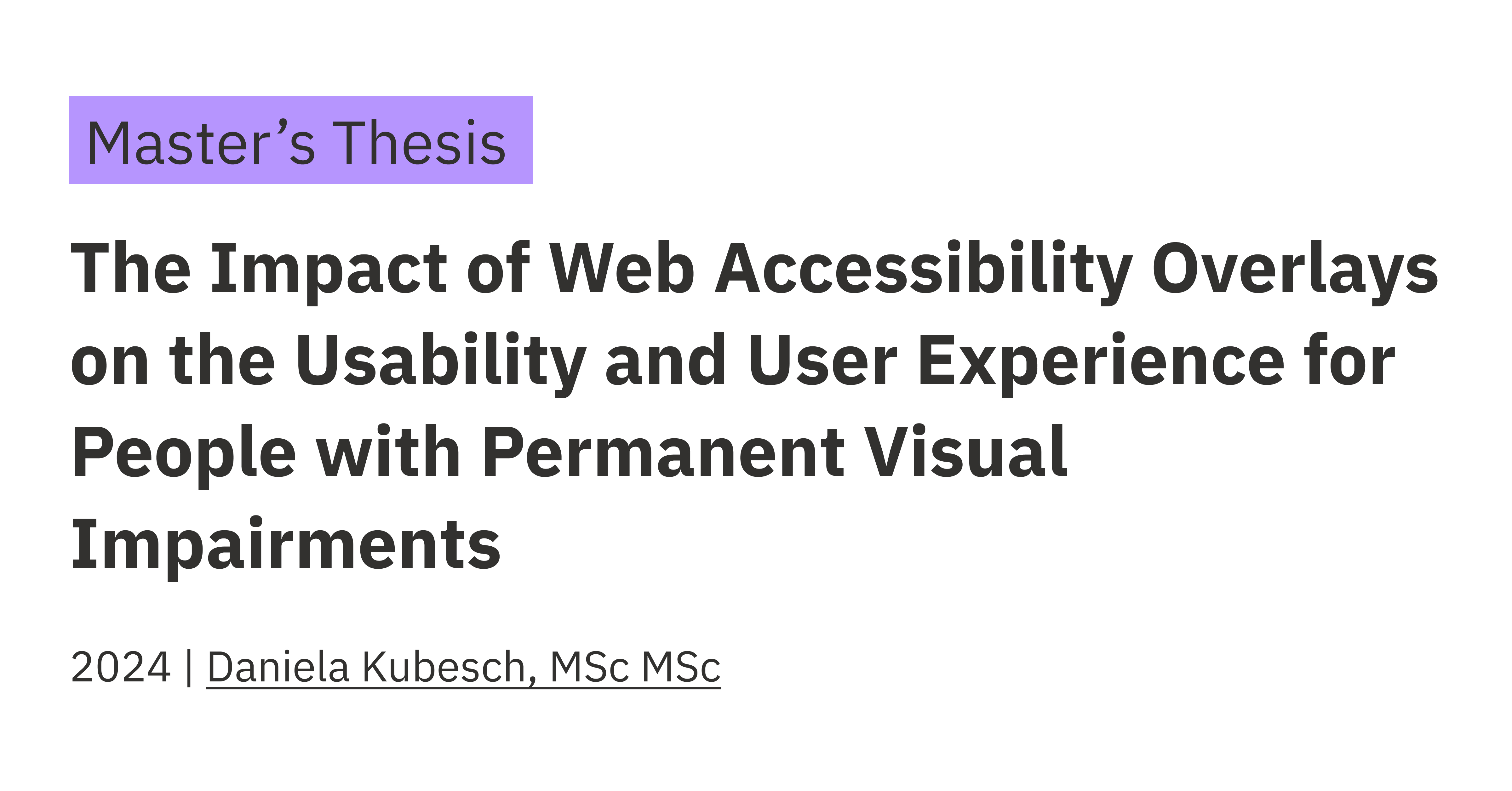
The current form of accessibility overlays does not deliver on their promises and was identified as disability dongle, meaning "an outcome in which designs or technologies 'for' disabled people garner mainstream attention and accolades despite valid concerns disabled people have about them" (Jackson, Haagaard, and Williams 2022). In conclusion, the author suggests teaching individuals with impairments how to operate access technology instead of teaching them to use accessibility overlays in their current form. Further, it is proposed to design and program accessible websites following accessibility standards, such as the WCAG, as various legal regulations require. At the same time, the research showed and agrees with previous research, that individuals with diverse impairments must be incorporated into the development process to understand user needs, identify errors that go beyond the WCAG success criteria and create usable products.
AccessiBe appoints Robert Lopez as its new CEO. Lopez was the Chief Revenue Officer at Justworks, is responsible for driving the company's revenue growth and overseeing sales strategies. He was previously Groupon's GM and Head of Sales, and advisory positions at Tidemark and Spark Capital.
He has no background or experience in accessibility or disability.
Frank Elavsky illuminates the ways overlay companies have succeeded because of fear as they ruin personalization and infringe on privacy.
I view accessibility overlays like Ivermectin: they are entirely a grift that enables people to continue to make bad decisions.

The Federal Trade Commission has closed public comments on their proposed Consent Order against accessiBe. There were 54 in total, including from the National Federation of the Blind. With two exceptions (one was withdrawn as "unrelated comment" and another just said "looking for more information"), every single public comment supported the ruling. Many considered the proposed fine of $1m to be a good start but woefully inadequate.
After conducting an investigation, the United States Federal Trade Commission orders accessiBe to pay $1 million for its deceptive claims.
First, the order would bar the company from representing that its automated products, including accessWidget’s AI, can make any website WCAG-compliant or can ensure continued compliance with WCAG over time, unless it has the evidence to support such claims...
 Kyle Wiggers
The order was voted on unanimously by all five FTC commissioners.
On January 6, 2025, accessiBe published a comment in Jewish Business News, saying what anyone would expect them to say.
"Following an FTC investigation, which focused on the past, 2019-2022, accessiBe has reached a settlement that does not include any admission of liability," said the company. "The company completely denies the FTC's allegations and believes that they are largely based on deficient testing and rely on outdated information. The FTC's complaint in no way attacks the capabilities of accessiBe's technological solutions to ensure that its clients' websites comply with accessibility regulations in the U.S."
In spite of this bluster, the FTC unanimously approved the final order requiring accessiBe to pay $1m on April 22, 2025.
The final order bars accessiBe from representing that its automated products can make any website WCAG-compliant or can ensure continued compliance with WCAG over time, unless it has the evidence to support such claims.
 Stephanie T. Nguyen, Chief Technologist
Léonie Watson of Tetralogical presents AI and Accessibility: the Good, the Bad, and the Bollocks at ffconf 2024, reminding us among other things that an overlay that's "powered by AI" is still an overlay.

AudioEye claims to offer "up to 400% more protection" than its competitors by launching a clever new accessibility-protection-money scheme that will allow them to conflate their service with some kind of "compliance standard."

Best paired with a substantial grain of salt. 400% of nothing is still nothing.
A helpful email template to use to inform businesses that use overlays about the risks and pitfalls:


A proper research study with blind participants affirms what overlay skeptics have been saying for years. From the paper's abstract (emphasis ours):
Despite their intended purpose, accessibility overlays often fail to deliver on their promises and, in many cases, increase existing challenges. Participants frequently reported that these overlays conflicted with their assistive technologies, leading to reduced functionality and increased frustration. This points to a significant misalignment between the design of these tools and the real-world needs of users. The study highlights the pressing need to move away from superficial technological fixes and towards deeper, more meaningful engagement with the needs of disabled users.
 Authors Info & Claims
In another class action lawsuit filed Delaware, UserWay is accused of making misleading claims about its accessibility widget.
Plaintiff brings this action seeking damages caused by Userway’s misleading and false representations in its advertising, its direct marketing, its standard form correspondences with customers, and in its standard form contract regarding its “overlay” products that purport to adjust any website’s underlying code to ensure that the website meets all legal and regulatory standards needed to comply with Title III of the Americans with Disabilities Act (“ADA”). Plaintiff further seeks injunctive relief that would require Userway to discontinue its deceptive practices...
 Nickie Louise

Chris Coyier doesn't trust an overlay not to inject a bitcoin miner, a concern that isn't unfounded given previous cases of a overlays being exploited by hackers.
 Kazuhito Kidachi
In a lawsuit filed in the Supreme Court of the State of New York, AudioEye and its CEO are being sued by David Kovacs, a former employee turned whistleblower, for running a stock manipulation scheme.
The complaint contains threats to revoke health benefits for noncompliance with the scheme and quotes like "I am the law, I have the best lawyers in the world, I will never be in trouble, buddy." Perhaps they don't remember having to settle a lawsuit for securities fraud to the tune of ~$1.5 million in 2017.
 Walden Macht & Haran LLP
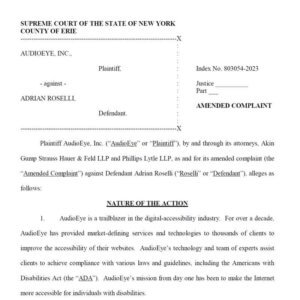
AudioEye and its CEO had also attempted on April 10, 2024 to silence Kovacs with an anti-defamation lawsuit. Seems like it didn't work.
The Tribeca Skin Center has filed a class action lawsuit against accessiBe in the southern district of New York for making false claims.
“Accessibe advertises that its products will lower the likelihood that customers will be sued for violations of the ADA. Accessibe’s claims in this regard are false. In fact, businesses that use Accessibe’s products are more likely to be the targets of lawsuits. Use of Accessibe’s widget serves as a signal that a business has used a flawed shortcut to make its website accessible to people with disabilities—one that actually impedes visually impaired people from using the website.”
Among other things, the plaintiffs seek not only restitution of subscription fees paid (by them and all of accessiBe's customers) as well as injunctive relief to stop Accessibe’s deceptive practices and inform current subscribers of the ineffectiveness of the product.
Update: On September 16, accessiBe's counsel appears to take the stance that their Terms of Service explicitly disclaim any warranty that a customer's site will be rendered accessible. On September 20th, the plaintiff responded:
Accessibe states an intent to argue that its Terms of Service contains waivers that effectively shield it from liability for any of its misrepresentations, deceptions, and breaches of express contractual terms. While the substance of this argument is dubious, a threshold question will be whether the Terms of Service are binding at all.
An article on Forbes entitled How Level Access Acquiring UserWay Transforms The Web Accessibility Market is published through a contributor content program. It is almost certainly an astroturfing effort to counter criticism of the recent marriage of the two companies.
Further reading:
AudioEye hires Mike Paciello, long-time accessibility champion and founder of WebABLE, as Chief Accessibility Officer.
AudioEye, Inc.
[eldritch thrumming]
The IAAP issues a forceful statement about the Zero Project Conference.

AudioEye and Adrian Roselli reach a settlement agreement, resulting in AudioEye dropping its SLAPP lawsuit.
The CEO of AudioEye publishes blog post that some perceived as patronizing, in an attempt to clarify and defend the company's reputation.
According to UsableNet's 2023 Digital Accessibility Lawsuit Report (PDF), 30% of all state and federal lawsuit were connected to these overlays. In plain numbers, businesses using accessibility widgets received 933 lawsuits in 2023, a 62% increase from 2022. Many of these lawsuits list the widget features and functionality as accessibility barriers, as well as typical WCAG failures.
 Level Access
[wet squelching noises]
Further reading:
The European Commission takes a strong internal stance on overlays in a statement that was not intended to be public (though it was publicly viewable for several months):
"Claims that a website can be made fully compliant without manual intervention are not realistic, since no automated tool can cover all the WCAG 2.1 level A and AA criteria. ... In other words, overlay tools may make a website less accessible for some users."


An archived version of the page, as the Europa Web Guide is for the European Commission's own staff and its contractors.
Update: On February 21, 2025, a new public statement was published, which states:
Overlays, or any other tools which do not ensure the website itself meets the detailed criteria of the standard, are not an appropriate solution. It is best to fix accessibility issues at their source.


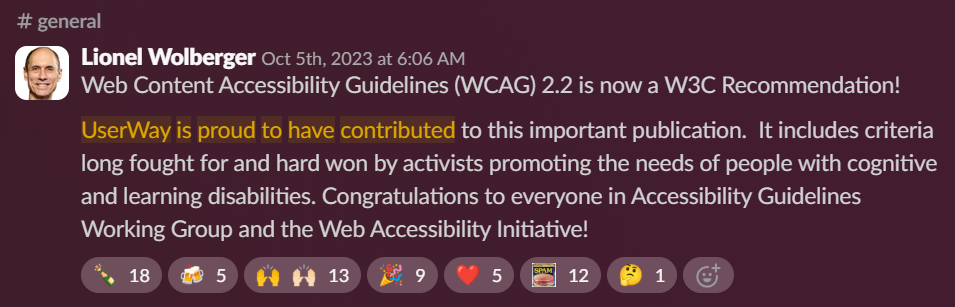
In the A11y slack, UserWay COO Lionel Wolberger audaciously claims credit (image link) for contributing to the W3C Recommendation of WCAG 2.2.
UserWay is proud to have contributed to this important publication. It includes criteria long fought for and hard won by activists promoting the needs of people with cognitive and learning disabilities. Congratulations to everyone in Accessibility Guidelines Working Group and the Web Accessibility Initiative!
Their "contribution" was litigating the use of the a single adverb.
 w3c
w3c
To choose a single word for this: mierenneuken.
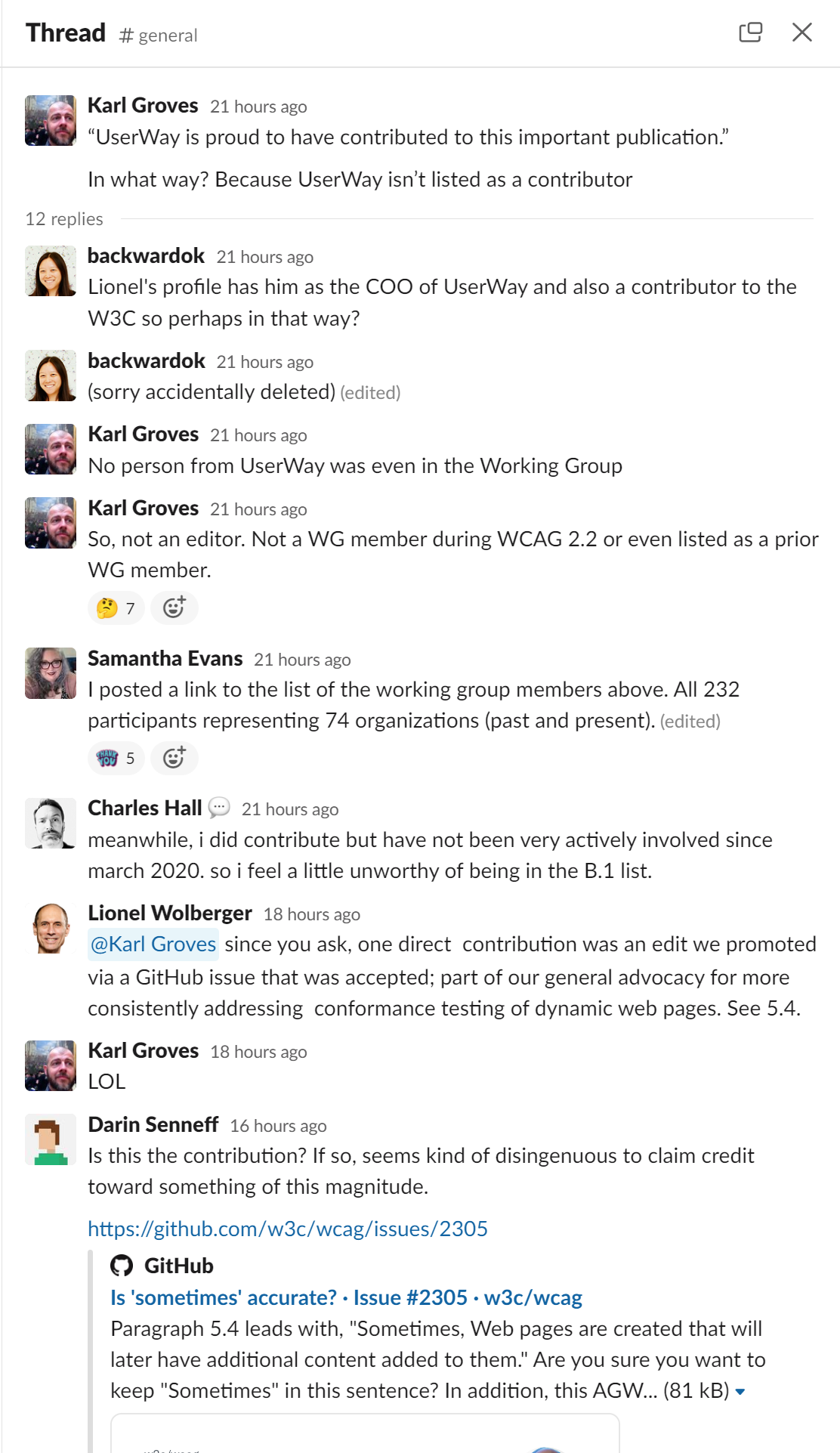
This prompted a rebuke (image link) from other members. Wolberger's responded:
...since you ask, one direct contribution was an edit we promoted via a GitHub issue that was accepted; part of our general advocacy for more consistently addressing conformance testing of dynamic web pages. See 5.4.
Though the contribution of course had nothing to with addressing conformance testing, but the behavior is consistent with the pattern of such companies making unfounded claims.
AudioEye went on a PR blitz to announce they won an award for 2023's most innovative accessibility product. This was picked up by Forbes contributors and many other small startup news outfits.
AudioEye, Inc.It doesn't matter that those sites generate little traffic or that few have ever heard of the award in question or the group that granted it. The dozens of published articles help flood search results for a controversial product with more favorable headlines.
The Cloud Awards and its many programs are not about merit or actual innovation. You pay a fee to enter, are incentivized to nominate yourself for many different categories within each program, and they help you with the PR and marketing if they like you most. They're very forthcoming about all of it.
We're including this on the timeline to give an example of how awards can be a form of astroturfing.
A brief respite from Webbed Briefs.
Make Things Accessible sums things up and explains how to respond to suppliers using overlays.
 [object Object]
UserWay removes all code that changes page content when the WAVE accessibility extensions are activated. WAVE makes plans to remove the warning message about such changes on pages with UserWay installed. accessiBe continues to change page content.
WebAIM releases an update to WAVE accessibility tools that informs users that accessiBe and UserWay overlays may manipulate page content to suppress detection of accessibility errors, such as making all text black on white, give all images alt="image", etc. resulting in zero WAVE errors.
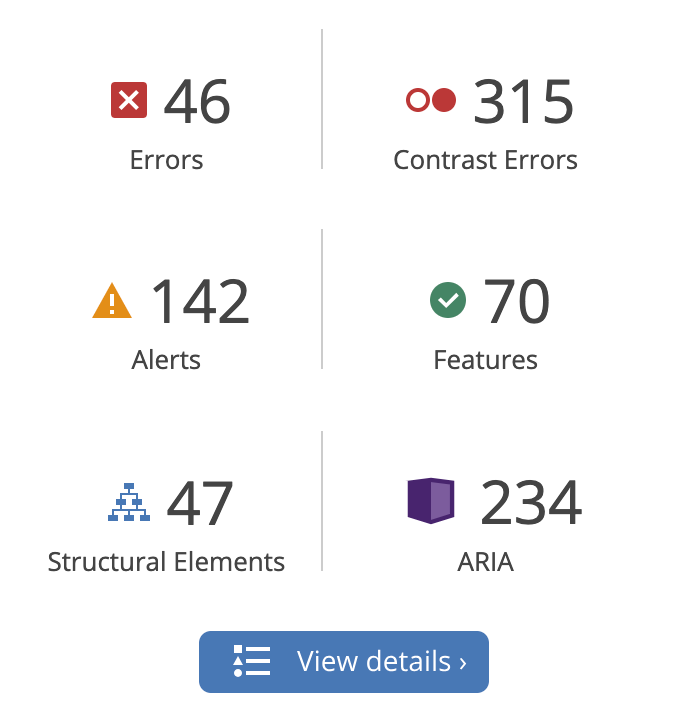
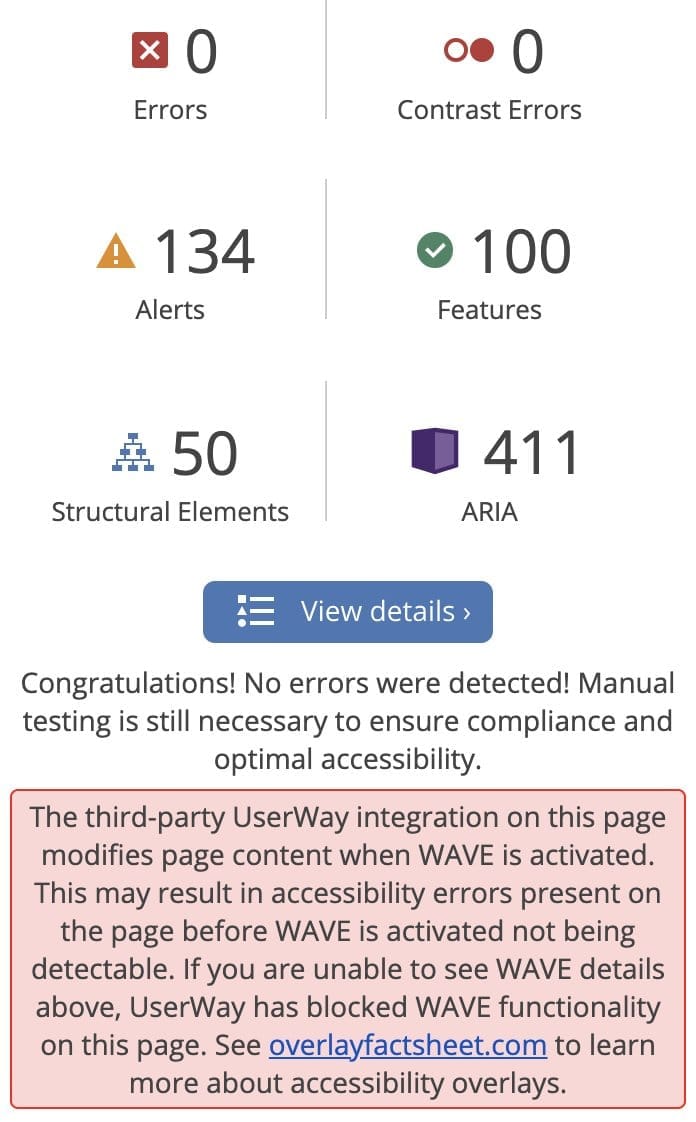
A side by side comparison of WAVE results. On the left, a page has 361 detectable errors in its default state. On the right, WAVE is activated on a page with UserWay activated. No errors are detected, and there is a warning message stating that UserWay may be manipulating the page to block WAVE functionality.
Though it won't be noticed until many months later, accessiBe memes and hashtag spam floods social media timelines during Global Accessibility Awareness Day 2023. Some of the accounts posting the memes belong to entirely fake businesses with fake websites and sock puppet social media accounts.
 Jan Maarten
This is 17 days after accessiBe apologizes to the NFB and claims that their marketing department and its leadership have been overhauled.
The IAAP (finally) acts in the interests of people with disabilities by issuing a joint statement with the European Disability Forum on accessibility overlays.
"Claims that a website can be made fully compliant without manual intervention are not realistic, since no automated tool can cover all the WCAG 2.1 level A and AA criteria. It is even less realistic to expect to detect automatically the additional EN 301549 criteria. Moreover, automatic repair is more challenging than the automatic detection of accessibility failures."
Read the full statement.
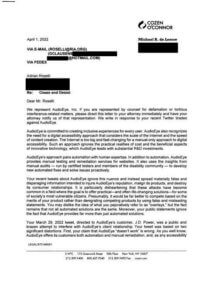
The IAAP promotes overlay vendor's event for Global Accessibility Awareness Day even while the overlay vendor is going after accessibility expert Adrian Roselli with a SLAPP lawsuit.
Nearly two years after the National Federation of the Blind banned AccessiBe from their conference, the founder of AccessiBe publishes an "apology" on the NFB's Braille Monitor.
Aside from announcing that the Chief Marketing Officer has been replaced, it includes no concrete steps for repairing harm or trust. No such apology or plea for a second chance or attempt at reputation-washing appears on any AccessiBe press release, social media, or comms to customers. (It was eventually added to their website through an unannounced link deep in their footer navigation.)
 Tanner Kohler
Follow-up piece on YouTube: Accessibility Widgets Are Not Enough for Screen-Reader Users
According to UsableNet's 2022 Digital Accessibility Lawsuit Report (PDF), businesses using accessibility widgets received 575 lawsuits, a 36% increase from 2021. Many of these lawsuits also list the widget features as a barrier to equal access in addition to WCAG violations and other user web barriers.
accessiBe publishes a blog post claiming that clients qualify for a tax break under the Americans with Disabilities Act. This claim is very likely false, and would only be worth $120 (if it were true).
A conference paper comparing accessiBe, UserWay, and EqualWeb raises two questions:
 Niklas Egger
UserWay executives and advisors (and one person from AudioEye) propose an overlay W3C Community Group to artificially boost their credibility and legitimacy.
 John Foliot
 John John
Deep link to the "UserWay Tries to Cash in on W3C Brand" section of Adrian Roselli's continuous cataloging of the overlay company's behavior.
The US Department of Justice publishes new guidance on web accessibility, which cautions that overlays don't guarantee accessibility, but offers nothing substantive to enforce this or protect vulnerable businesses.
DOJ's long-awaited guidance reaffirms the DOJ's commitment "to using its enforcement authority to ensure website accessibility for people with disabilities." However, it does little to resolve the key legal issues that render businesses vulnerable to accessibility lawsuits.
 Caren Decter
The IAAP releases "State of Overlays & My Work with IAAP on Grievance Process and Policy Infrastructure" from a procedural consultant.
Two days after promoting AudioEye's blog post on Twitter, the IAAP responds to backlash with an Accessibility Overlay Feedback Survey, which includes the statement:
We are fully aware of the concerns regarding false advertising and deceptive marketing issues by some overlay vendors and the dangers that they may present.
IAAP does not support vendors making false claims or participating in deceptive marketing on or about their own or others’ products and services.
The IAAP Overlays Task Force is currently conducting due diligence on the issue to determine IAAP’s course of action considering experts’ advice and members’ perspectives.
The IAAP promotes an AudioEye blog post on Twitter.
The backlash from this sets off multiple efforts to revisit their grievance process, form the IAAP Overlays Task Force, and eventually publish an official position on overlays.
According to UsableNet's 2021 Digital Accessibility Lawsuit Report (PDF), there were 4,055 lawsuits filed about websites, apps, or video content under the ADA this year. Of those, 430 companies who have an accessibility widget or overlay on their website have been sued.
The promise to prevent ADA lawsuits by using an accessibility widget or overlays isn't real. Many lawsuits in 2021 list widgets and overlay features as a barrier to equal access in addition to other inaccessible aspects of the website. This means these approaches give plaintiffs more claims to add to a lawsuit, not less.
Disability Rights Advocates announces it has settled its lawsuit against ADP on behalf of San Francisco’s LightHouse for the Blind and Visually Impaired. ADP had been using an AudioEye overlay.

 David Thompson
FACIL'iti wins their lawsuit against accessibility consultancy Koena over a series of critical tweets. Koena is ordered to pay 26,256€ ($28,302.86 USD) for the crime of publishing a couple of tweets.

A class action lawsuit against Eyebobs for using accessiBe has been settled.
Defendant installed a low-cost overlay on the Digital Platform developed by a company called accessiBe. accessiBe claims this overlay can bring a website into compliance with the ADA by resolving the website’s underlying accessibility issues. Unfortunately, the overlay fails to provide screen reader users, including Murphy, full and equal access to the Digital Platform.
In the first week of September 2021, five companies using accessiBe overlays are sued in the state of Pennsylvania for failing to make their websites accessible to blind individuals, thus violating Title III of the Americans with Disabilities Act.
In a special email blast (i.e. not their regular newsletter), the IAAP emailed their entire membership on behalf of AudioEye to solicit free data from people who use assistive technology.
The AudioEye A11iance Team have been conducting research alongside users with disabilities to explore experiences and preferences when browsing the web using assistive technology. The program is progressing well, now we are seeking answers from accessibility professionals who use AT. Historically, there is little data available from AT users themselves and their thinking on digital accessibility, and we know all technologists can benefit from their opinions and experiences.
Please take some time to share your thoughts on these important data points and we, in turn, will share the results in a blog and webinar once the survey closes. Thank you in advance!
The survey yielded numerous anecdotes and figures that would be used in marketing materials and numerous sponsored articles. Perhaps this contributed to some substantive change for the accessibility field and the disabled people we aim to help. Or perhaps the IAAP only helped create some shoddy research collateral to help an overlay company with their marketing. That way, said company could rely on their own "research" and point to themselves in their press blitz rather than countless other studies that have provided the pretty much the same anecdotes and figures.
A week later, on August 30, the IAAP's regular newsletter contains another plea for all of their members to participate in the AudioEye survey.
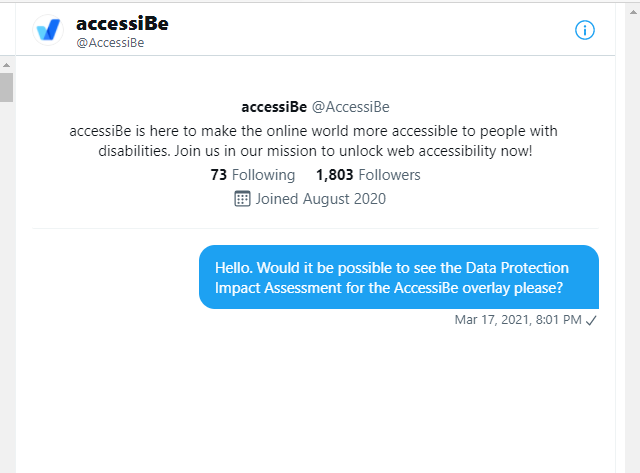
Léonie Watson examines the privacy risks of overlays and makes a compelling case. The questions she addressed to accessiBe about their Data Protection Impact Assessment were never answered.

The National Federation of the Blind bans accessiBe from its National Convention.
“This week, the Board of Directors reviewed accessiBe’s business practices at the urging of members who have researched and interacted with the company, and the Board believes that accessiBe currently engages in behavior that is harmful to the advancement of blind people in society.”
accessiBe is named in the Fischler et al v. Dorai Homes lawsuit as a direct cause of an access barrier.


FACIL'iti serves a subpoena to an accessibility consultant over a deleted tweet, demanding up to €10,500 in damages and fines.
In reply to a tweet from French Minister of State for Digital and Telecommunications in November 2020 which praised overlay vendor FACIL'iti, many people replied to assert that overlay do not make a website accessible. One reply received a whole 9 retweets and 32 likes. FACIL'iti responded in December 2020 by sending a legal threat to the author's employer. Though the author deleted the tweet, FACIL'iti sent a second threat (again, to the person's employer) in March 2021.
There have been multiple hearings as well as mediation between the two parties since then. The current state of this effort to silence any criticism is unknown.
 Julie Moynat
Further reading:
AccessiBe shares a post on LinkedIn with a comic attached that frames accessibility work as an extortion racket.
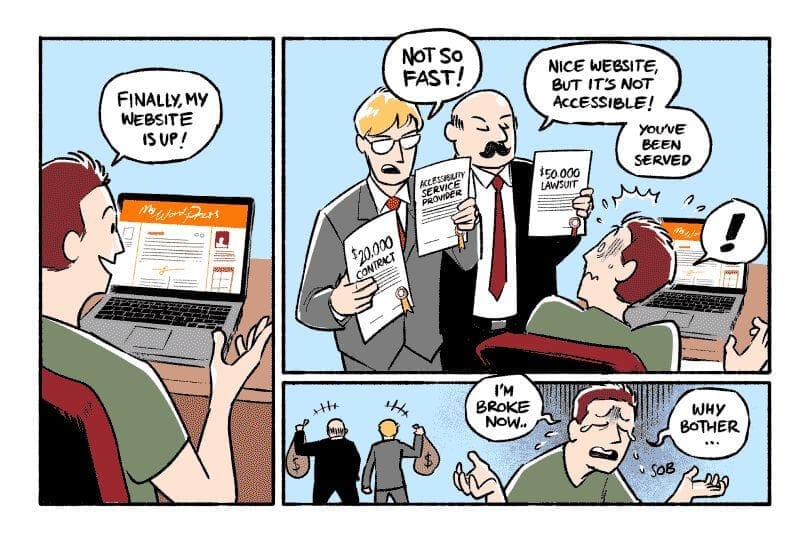
The National Federation of the Blind publishes a statement critical of overlays in the Braille Monitor.
...The overlay only professes to address the accessibility of the website; it does nothing to assist the executives, managers, and frontline workers to understand the policies, procedures, and systems required to enculturate accessibility.
Disability Rights Lawyer Haben Girma also implores people to avoid overlay companies:


The CSUN Assistive Technology Conference briefly implements an overlay during its event registration. After an outcry, it is removed. CSUN makes it clear that this was a mistake, and that they do not endorse the overlay.
Karl Groves launches OverlayFactSheet.com to better inform accessibility practitioners and potential clients of overlay vendors about the nature of this type of product and the falsehoods surrounding them.
Nearly 1,000 signatories would go on to pledge:
Signatories from over a dozen nations included contributors to WCAG, ARIA, and HTML specifications, contributors to assistive technology software such as JAWS and NVDA, lawyers for the disabled, many end users with disabilities. It was endorsed by experts from companies like Google, Microsoft, Apple, NBC, Squarespace, BBC, VMWare, Shopify, ServiceNow, Dell, Lyft, Costco, Target, CVS Health, and more. And from experts at higher education institutions like Syracuse, CSU, University of Massachusetts, San Francisco State University, Carnegie Mellon, MIT, and others.
According to UsableNet's 2020 Digital Accessibility Lawsuit Report (PDF), there were over 250 companies with an accessibility widget or overlay on their website were sued. The last 6 months of 2020 shows a significant increase in cases filed at a rate of more than one new lawsuit every day.
accessiBe shares an unlisted video response to Adrian Roselli's comments that is over 2 hours long. It contains a long product pitch and a demo using an optimized version of their product (which is not the same as the accessiBe overlay present on many client sites). Some issues are claimed to be bugs, followed by assertions that they work perfectly. Adrian's response is thorough.
Adrian Roselli writes that accessiBe will get you sued. He documents how the product is inaccessible, the multiple lawsuits that the overlay vendor is named in, how they pays for praise, delete critical comments, spoof automated checkers, misrepresent the ADA, and does not understand WCAG, and much more.
Timothy Springer, CEO of Level Access, wrote an article called "Lies, Damned Lies, Overlays and Widgets," which thoroughly explores the shortcomings of accessibility overlay products. He argues that these products over-promise and under-deliver, putting clients and users at risk while failing to achieve true ADA compliance.
"...lots of organizations do seem to shrug and say something like, "Let's take the cheaper route and take our chances." The problem with that approach is it accepts that ongoing discrimination is okay."
Despite this principled stance, Springer would later lead Level Access to acquire UserWay, a company that provides accessibility overlay solutions, for $99 million. This acquisition raises questions about whether Springer's views on accessibility overlays have changed, and whether he now believes that some level of discrimination is acceptable.
The Next Web publishes an article paid-for by ACE, an accessiBe product. This is disclosed only at the end of the article, which boasts about how accessiBe uses AI, has tested 10 million websites, and is very affordable. Especially given the legal risks of using it, it's none of these things.
 Andrea Hak
Adrian Roselli also uncovered nearly a dozen instances of paid praise in tweets from marketers that point to these fluff pieces.
 TPGi
TPGi Steve Faulkner
Sheri Byrne-Haber, CPACC writes that overlays are not the solution to your accessibility problem. In the long run they will hurt, not help your approach to people with disabilities.
Overlays are, by their very nature, another attack surface and potential vulnerability for your website. Hundreds of websites learned this the hard way.
 Balaji
The Nagich overlay was created by the same folks behind Allyable and EqualWeb.
Karl Groves writes Automated Lies, with one line of code, a thorough accounting of why you cannot magically automate your way into compliance.
AudioEye settles a class action lawsuit for securities fraud to the tune of ~$1.5 million